


Swiss watch exports to the United States fell 19.4 percent to CHF 197.5 million in August 2026, according to figures the Federation of the Swiss Watch Industry (FH) released on 17 September, while world exports rose 9.1 percent to CHF 1,789.2 million. The United States is still the largest single market for Swiss watches, but its 11.0 percent share is the smallest of any month this year, and it follows a July spike to CHF 701.3 million. This is the autumn sequel to our Pre-Owned Watch Market, Summer 2026 report.
Key facts
- Swiss watch exports to the United States were CHF 197.5 million in August 2026, down 19.4 percent year on year (FH, 17 September 2026).
- Total Swiss watch exports in August 2026 were CHF 1,789.2 million, up 9.1 percent, with one more working day than August 2025.
- The United States remained the No. 1 market for Swiss watch exports in August 2026 with an 11.0 percent share, ahead of the United Kingdom (CHF 164.7 million, 9.2 percent); Hong Kong ranked sixth at CHF 117.6 million.
- Swiss watch exports to the United States reached CHF 701.3 million in July 2026, up 26.5 percent and equal to 26.7 percent of all Swiss watch exports that month.
- Since 24 July 2026, Swiss goods entering the United States face a Section 301 tariff of up to 12.5 percent, offset by the existing most-favoured-nation (MFN) duty, according to Switzerland's State Secretariat for Economic Affairs (SECO).
- US import tariffs are charged when goods enter the country; a pre-owned watch already inside the United States does not incur a new import duty when it is resold domestically.
- The WatchCharts Overall Market Index stood at 38,518 on 30 September 2026, up 8.3 percent over one year and down 0.2 percent over one month.
- EveryWatch put global secondary watch sales at $10.5 billion in the first half of 2026, up 37 percent, with Rolex at $4.3 billion (WatchPro, 4 August 2026).

August 2026: the export numbers
Swiss watch export statistics are the monthly figures FH compiles from Swiss customs declarations, valued at export prices, not retail sales to consumers. It matters more when shipments are timed around tariff dates.
Wristwatch exports rose 8.6 percent to CHF 1,704.5 million on 1.1 million units, led by bimetallic watches (+20.1 percent). Watches with an export price above CHF 3,000 rose 10.2 percent, while the CHF 500 to 3,000 band slipped 0.9 percent. The cumulative result for January to August passed CHF 17 billion, up 1.7 percent, and the twelve-month moving average turned positive for the first time in two years.
FH's own wording on the US is blunt:
"Despite a favourable basis for comparison, exports to the United States declined sharply in August (-19.4%). Conversely, the other main markets grew to a more or less significant degree."
Federation of the Swiss Watch Industry, Swiss watchmaking in August 2026
Some coverage suggested Hong Kong had overtaken the United States. The FH release does not support that. The six main markets in August were the United States (CHF 197.5 million, 11.0 percent share), the United Kingdom (164.7 million, +46.1 percent), France (157.3 million, +113.5 percent), Japan (135.8 million, +22.1 percent), China (133.5 million, +15.8 percent) and Hong Kong (117.6 million, +1.4 percent). JCK reached the same reading: the US "remained the largest single market." FH cautions that France's figure may reflect "a communicating vessels effect" at the expense of other EU markets.
The US series, January to August 2026
Each figure below is taken from FH's monthly press release for that month, as first published. FH notes that data can be revised.
| Month (2026) | US exports (CHF million) | Change vs 2025 | US share of Swiss exports |
|---|---|---|---|
| January | 325.9 | -14.0% | 17.0% |
| February | 431.5 | +26.8% | 19.9% |
| March | 398.9 | -1.6% | 18.9% |
| April | 372.3 | -56.4% | 17.5% |
| May | 301.5 | +12.3% | 14.3% |
| June | 349.0 | +12.7% | 14.6% |
| July | 701.3 | +26.5% | 26.7% |
| August | 197.5 | -19.4% | 11.0% |
Summed, the eight releases come to roughly CHF 3.08 billion. Two months stand out: April, down 56.4 percent, and July. July 2026 is the more interesting outlier: FH described the US as "the main driver of overall performance," maintaining double-digit growth for a third consecutive month "despite an unfavourable base effect." That base was itself inflated: JCK reported in August 2025 that July 2025 exports to the US jumped 45 percent "as manufacturers rushed to beat the 39% tariff."
No source we have found attributes the July 2026 surge to front-loading. FH does not. What follows is Honeyrock's reading, not reported fact: a CHF 701.3 million month followed by a CHF 197.5 million month, bracketing the 24 July change of tariff authority, is the shape you would expect if brands and distributors moved stock into US warehouses before the new regime and then had little left to ship. September's figure, due 20 October, will test that reading.
The tariff timeline, corrected and current
Our summer report, written the day after the Section 122 authority lapsed, said no successor had been reported. One has. The table below is drawn from SECO's official page on Swiss-US trade relations, Honigman's 24 July client alert and GHY International's customs bulletin.
| Effective date | Legal basis | Additional US tariff on Swiss goods |
|---|---|---|
| 7 August 2025 | IEEPA reciprocal tariff | 39% |
| 14 November 2025 | Joint US-Switzerland statement | 15% ceiling |
| 20 February 2026 | US Supreme Court ruling | IEEPA basis found insufficient |
| 24 February 2026 | Section 122, Trade Act of 1974 (150 days) | 10% on top of the MFN duty |
| 24 July 2026 | Section 301, Trade Act of 1974 | Up to 12.5%, offset by the existing MFN duty |
SECO describes the current measure precisely: "A variable additional tariff of up to 12.5% will be levied on imports from Switzerland, offset by the existing most-favoured-nation (MFN) duty." Its own worked example: if the MFN duty on a product is 5 percent, the new additional tariff is 7.5 percent, "bringing the total US tariff on Swiss goods to 12.5%." SECO also notes that, following the Supreme Court ruling of 20 February 2026, US importers of record can claim reimbursement of tariffs paid under the IEEPA regime. Honigman frames it the same way, as a rate sufficient to bring the combined MFN and Section 301 rate to 12.5 percent, effective 12:01 a.m. on 24 July 2026.
A Small Seconds explainer dated 22 September describes the Section 301 position as an unconcluded investigation with no settled rate. We give more weight to SECO and Honigman, both of which describe a rate in force since 24 July: a combined burden capped at 12.5 percent, against 39 percent in August 2025.
What a tariff means for a watch already in the US
A US import duty is assessed when goods are entered into the United States, and it is paid by the importer of record at that point. A watch that cleared customs years ago and now changes hands inside the country does not cross a border again and attracts no fresh duty. Ariel Adams set this out at the height of the 39 percent period:
"A great way to avoid tariff-related price increases altogether is to purchase watches that are already in America."
Ariel Adams, aBlogtoWatch, 18 August 2025
His heading carried the qualifier: watches already in the US "Will Not Be Subject To Tariffs, But Demand Will Increase." Secondary pricing tracks replacement cost, and a new Swiss watch in America carries whatever tariff the brand passes on.
Secondary market: indices and premiums
The secondary market did not follow the export line down. WatchCharts indices, as of 30 September 2026, and the Morgan Stanley and WatchCharts Q2 2026 value retention scores (secondary price relative to retail, reported by WatchPro on 17 July 2026) sit side by side below.
| Brand | WatchCharts index (30 Sep 2026) | 1-year change | Q2 2026 secondary vs retail |
|---|---|---|---|
| Overall market | 38,518 | +8.3% | n/a |
| Patek Philippe | 141,244 | +17.6% | +15.4% |
| Rolex | 27,991 | +5.2% | +9.8% |
| Audemars Piguet | 79,693 | +8.5% | +3.0% |
| Cartier | 9,644 | +10.4% | -27.4% |
| Vacheron Constantin | 45,929 | +8.9% | -37.2% |
| Omega | 8,793 | +5.5% | -32.3% |
| IWC | 8,930 | +2.1% | -37.9% |
| Jaeger-LeCoultre | 10,860 | +6.4% | Not reported |
| Tudor | 3,574 | +13.7% | -25.7% |
Every brand index we track is higher than a year ago. Yet only Patek Philippe, Rolex and Audemars Piguet trade above retail on average; Vacheron Constantin, IWC and Omega still trade 32 to 38 percent below. Morgan Stanley's analysts concluded that value retention ratios point to limited pricing power outside the big three. Over the past month, the Overall index slipped 0.2 percent.
Volume tells the same story. EveryWatch's first-half tally, reported by WatchPro on 4 August, put global secondary sales at $10.5 billion, up 37 percent, with Rolex at $4.3 billion (+43.5 percent) and Patek Philippe at $1.5 billion (+40 percent). Rolex Certified Pre-Owned accounted for $385 million in the half, ahead of $335 million in grey market unworn Rolex sales.
Industry signals: Rolex UK, Goldman Sachs, the auction rooms
Rolex UK: accounts for financial year 2025, reported by WatchPro on 30 September 2026, show revenue of £736.7 million, up 5 percent, and operating profit of £87.1 million, down 10.4 percent. WatchPro attributes the profit decline to the pound weakening against the Swiss franc, the currency in which the subsidiary buys its watches.
Goldman Sachs: on 5 October 2026 the bank resumed coverage of the two Swiss groups, rating Swatch Group Sell with a CHF 174 target and Richemont Buy with a CHF 225 target, as cash.ch reported. The bank cited Swatch's comparatively heavy exposure to China and the Middle East, and a jewellery super-cycle favouring Richemont.
Auctions: Rolex's four unique "Four Seasons" Daytonas raised £37.3 million for charity at Phillips in London in September, and Sotheby's Hong Kong watch sale brought HK$426 million, and set a new Cartier auction record with a Cheich.
Honeyrock: current inventory
Honeyrock is a US-based dealer, and the watches below are current inventory. Each has been examined by Honeyrock's physician-led vetting team and carries our lifetime Authenticity Guarantee. Five are Swiss; the Grand Seiko is Japanese and sits outside the Swiss data.
| Watch | Reference | Listing | Price |
|---|---|---|---|
| Patek Philippe Nautilus Annual Calendar | 5726A-001 | 2017, unpolished, papers | $91,950 |
| Rolex GMT-Master II "Guinness" | 126713GRNR | 2026, two-tone, 40mm, full set | $23,490 |
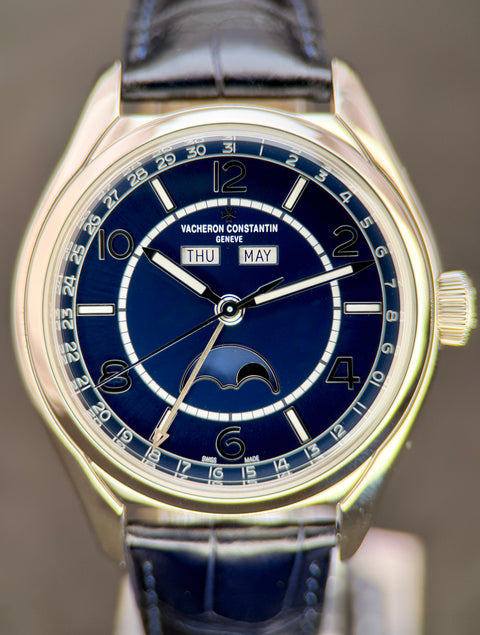
| Vacheron Constantin Fiftysix Self-Winding | 4600E/110A | 2022, blue dial, steel bracelet, full set | $14,365 |
| Jaeger-LeCoultre Master Calendar Meteorite | Q1558421 | 2018, 39mm, full set, two straps | $12,765 |
| Grand Seiko Evolution 9 Diver "Ushio" | SLGA023G | 2024, titanium, full set | $8,945 |
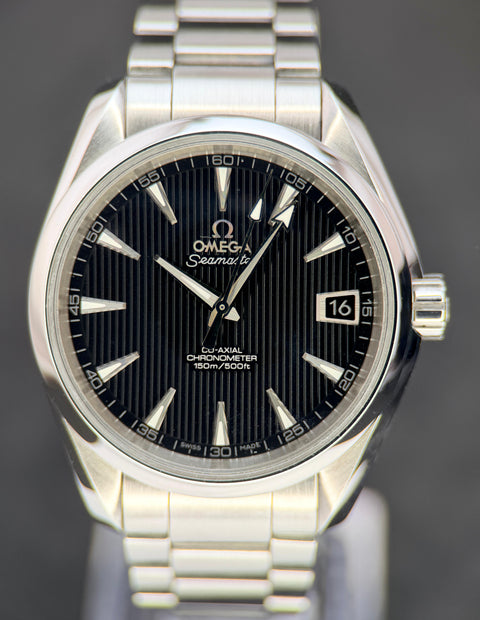
| Omega Seamaster Aqua Terra 150M "Skyfall" | 231.10.42.21.03.001 | 41.5mm, blue dial | $5,250 |
For the meteorite-dial JLC, see our Q1558421 guide; for the process of buying any of these at a distance, see how to buy a pre-owned luxury watch.
Frequently asked questions
How much did Swiss watch exports to the US fall in August 2026?
Swiss watch exports to the United States fell 19.4 percent in August 2026, to CHF 197.5 million, according to the Federation of the Swiss Watch Industry. Total Swiss watch exports rose 9.1 percent in the same month, to CHF 1,789.2 million.
Is the United States still the largest market for Swiss watches?
Yes. In August 2026 the United States remained the largest market for Swiss watch exports with an 11.0 percent share, ahead of the United Kingdom at 9.2 percent. Hong Kong ranked sixth with CHF 117.6 million.
What tariff applies to Swiss watches imported into the US now?
Since 24 July 2026, Swiss imports face a Section 301 tariff of up to 12.5 percent, offset by the existing most-favoured-nation duty, according to SECO. It replaced the 10 percent Section 122 tariff that applied from 24 February to 23 July 2026.
Do tariffs apply to a pre-owned watch already in the United States?
No new import duty applies when a pre-owned watch already in the United States is resold domestically, because US tariffs are charged at importation. Secondary prices can still reflect tariffs indirectly, through the retail price of new watches.
Why did Swiss watch exports to the US jump in July 2026?
FH reported Swiss watch exports to the US of CHF 701.3 million in July 2026, up 26.5 percent, without giving a cause. Honeyrock reads the July spike and August drop as consistent with stock moved ahead of the 24 July tariff change, but no published source has confirmed that.
When is the September 2026 Swiss watch export data released?
The Federation of the Swiss Watch Industry is scheduled to publish September 2026 Swiss watch export data on 20 October 2026.
Sources
- Federation of the Swiss Watch Industry: Swiss watchmaking in August 2026
- Federation of the Swiss Watch Industry: Swiss watchmaking in July 2026
- Federation of the Swiss Watch Industry: Statistics and publication schedule
- JCK: Swiss Watch Exports to the U.S. Fell Nearly 20% in August
- JCK: U.S. Swiss Watch Imports Soar in Effort to Beat Tariffs
- SECO: Swiss-US trade relations
- Honigman: Section 122 Tariffs Expire for Many Imports, But New Section 301 Forced-Labor Tariffs Replace Them, Effective July 24, 2026
- GHY International: U.S. 10% Section 122 Tariff in Effect Feb. 24
- Small Seconds: Why Swiss watch prices keep swinging
- aBlogtoWatch: According to Ariel: A Watch Buyer's Guide to Dealing With Tariffs and Trade Wars
- WatchCharts: Overall Market Index and brand indices
- WatchPro: Rolex, Patek and AP tighten secondary market grip
- WatchPro: Secondary market sales for Rolex alone could top $10 billion this year
- WatchPro: Hard facts about Rolex financials
- cash.ch: Swatch oder Richemont? Fur Goldman Sachs ist die Wahl klar
- Phillips: Four exclusive timepieces raise GBP 37.3 million for charity
- Artdaily: Sotheby's Hong Kong watch auction brings HK$426 million and sets new Cartier record